What a Ragdoll breeder's HCM and PKD testing claims actually mean
Any cattery can say "health tested." The useful question is which test, for which disease, at which lab, and whether it was run on this kitten or inferred from its parents.
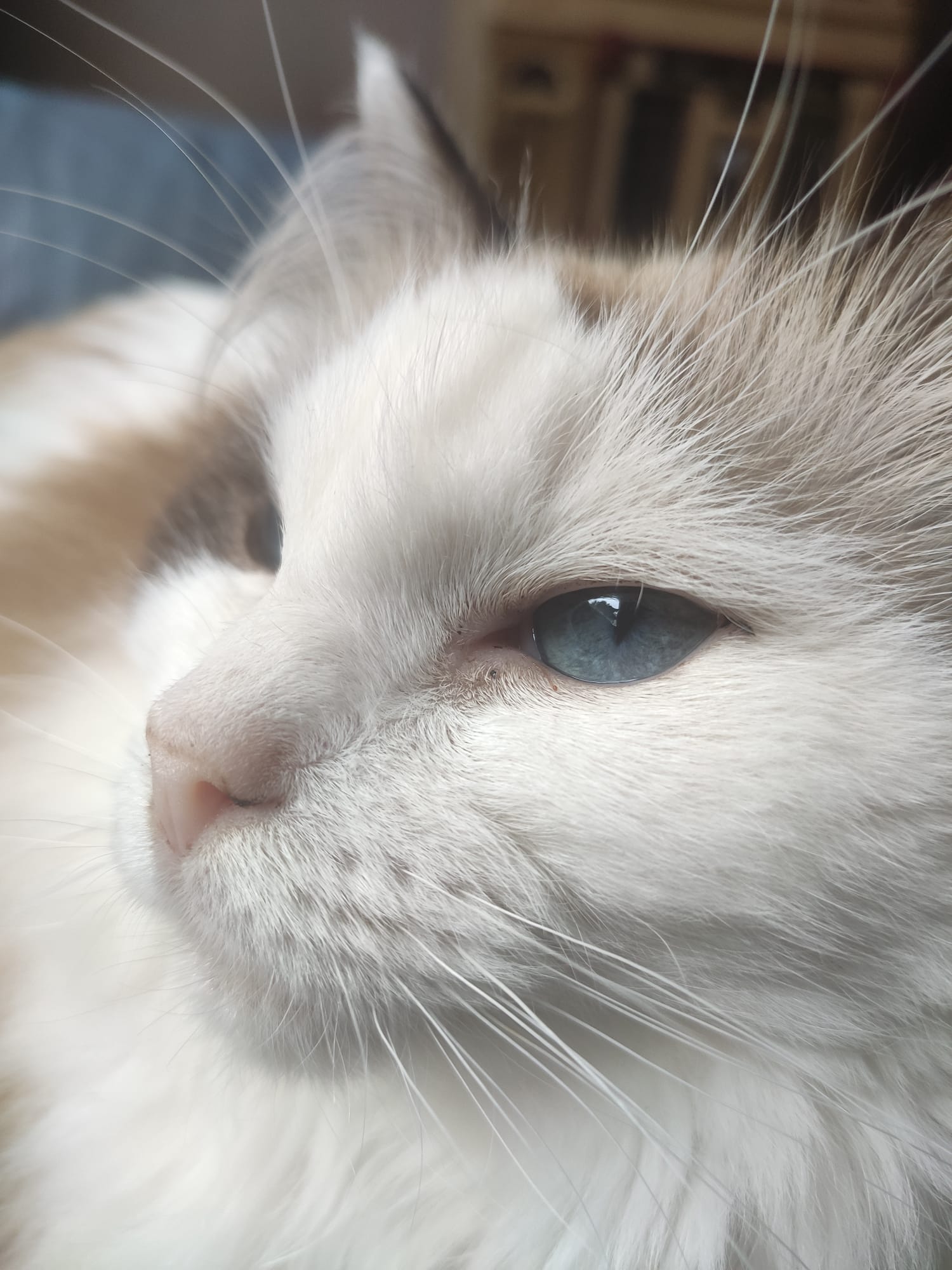
A calm temperament does not tell you anything about a cat’s heart or kidney genetics, only a named test does. Photograph by BigBlobfish, Wikimedia Commons, CC0.
Our choosing-a-ragdoll guide already covers the five signals that separate catteries in general. This page goes one level deeper on just one of them: what a named HCM or PKD test actually means, what it costs to run independently, and the specific questions worth asking before you treat "health tested" as settled.
Two different diseases, one word: "tested"
Hypertrophic cardiomyopathy (HCM) is a heart-muscle disease. The DNA test breeders name most often looks for the R820W mutation in the MYBPC3 gene, a marker the UC Davis Veterinary Genetics Laboratory and NC State's College of Veterinary Medicine both run as a dedicated Ragdoll test. Polycystic kidney disease (PKD) is a kidney disease that is mostly a Persian and Persian-outcrossed problem; Ragdolls are considered low-risk rather than zero-risk, because of historical crossing with Persian lines generations back. That is why several labs bundle a PKD screen into the same panel as HCM for one extra fee, rather than treating it as a Ragdoll-specific concern on its own. Both are DNA tests run from a cheek swab or a blood sample, not an ultrasound, though a vet can also check the heart directly by echocardiogram if a breeder's paperwork does not cover it.
Tested vs. negative by parentage, three worked examples from our own list
Our Wilson Creek Ragdolls entry states HCM, PKD1, and FIV/FeLV testing through UC Davis and Wisdom Panel, on the cattery's own breeding cats. That is a direct result. Our Righteous Ragdolls entry states the breeding cats are DNA tested for HCM through UC Davis, and kittens are described as HCM negative by parentage; PKD is not stated. OurRagdolls and Rainbows entry states breeding cats are confirmed HCM negative, with PKD not stated either.
"Negative by parentage" means the kitten itself was not tested; its status is inferred because the parents tested clear. That is a normal, reasonable practice, not a false claim. It is simply a different, less direct form of evidence than a result run on the kitten in front of you. Ask which one you are being told, and ask to see the parents' own paperwork if the kitten was not tested directly.
What the DNA test itself costs, if you want a second opinion
These are the labs' own published fees for the test alone, not a vet visit or sample collection fee, and not an endorsement of any one lab over another. They are listed so a breeder's claimed testing cost is checkable against a real number, not just taken on faith.
| Lab | What it tests | Cost | Turnaround |
|---|---|---|---|
| UC Davis VGL (Davis, CA) | HCM only | $47 per cat | About 15 business days |
| NC State CVM (Raleigh, NC) | HCM only | $35 per cat, $25 litter discount per kitten | Not published |
| Genomia (Czech Republic) | HCM, or HCM+PKD bundle | $42 single test, $34 each for 3+ | About 12 business days |
| LABOKLIN (UK) | HCM, or a 5-test bundle (HCM1, HCM3, PKD, pd-PRA, blood type) | £48 single test, £72 for the 5-test bundle | 1-2 weeks |
| Genimal Biotechnologies (EU) | HCM | €44.90 single test, €39.90 each for 6+ | 3-6 days standard, 3 days express |
Prices and turnaround times above are each lab's own published figures, checked directly against that lab's own test page as of 2026-07-27, not a market average. Currency is the lab's own listed currency; convert before comparing across countries. A sample is typically a cheek swab or a small blood sample in an EDTA tube, collected by a vet.
Questions worth asking, specific to HCM and PKD
- Which lab ran the test, by name? A breeder who tests will usually say UC Davis, NC State, or a similar named lab without hesitation.
- Was it run on this kitten, on its parents, or both? "Negative by parentage" is a real answer, just a different one than "this kitten was tested."
- Can I see the result itself, with the lab's name and the cat's identification on it?
- If PKD was not tested, why not? Several labs bundle it into the same HCM panel for one extra fee, so a confident breeder can usually explain the choice either way.
- How recent is the result? A breeding cat's status does not expire, but ask when the test was actually run.
Questions people ask about this
What is the actual mutation tested for Ragdoll HCM?
The test looks for the R820W mutation in the MYBPC3 gene, the specific marker associated with hypertrophic cardiomyopathy in this breed. It is a DNA test, run from a cheek swab or a blood sample, not an ultrasound or a physical exam, though a vet can also check the heart directly by echocardiogram.
Does "negative by parentage" mean the kitten is guaranteed clear?
No. It means the kitten itself was not tested; its status is inferred because both parents tested clear. That is a normal and reasonable practice, not a false claim, but it is a different, less direct form of evidence than a result run on the kitten in front of you. Ask which one you are being told, and ask to see the parents’ own paperwork if the kitten was not tested directly.
Is PKD actually a real risk for Ragdolls, or mostly a Persian problem?
Mostly Persian. Polycystic kidney disease is far more common in Persian and Persian-outcrossed breeds, and Ragdolls are considered low-risk, not zero-risk, because of historical crossing with Persian lines generations back. That is also why several labs that test Ragdolls for HCM bundle a PKD test into the same panel for one extra fee rather than treating it as a Ragdoll-specific concern on its own.
Can I pay for my own HCM or PKD test instead of trusting the breeder’s claim?
In most cases, yes, through the same labs breeders use, though a vet usually needs to collect and submit the sample. It only tells you about the specific cat tested, not the whole breeding program, so it is a way to verify one kitten, not a substitute for asking the breeder about their adults.
Sourced from the UC Davis Veterinary Genetics Laboratory, NC State College of Veterinary Medicine, Genomia, LABOKLIN, and Genimal Biotechnologies' own published test pages, checked against our own North Carolina cattery records as of 2026-07-27. RagdollFinder does not test cats, run a lab, or receive any fee from any laboratory named here.